
 Looper
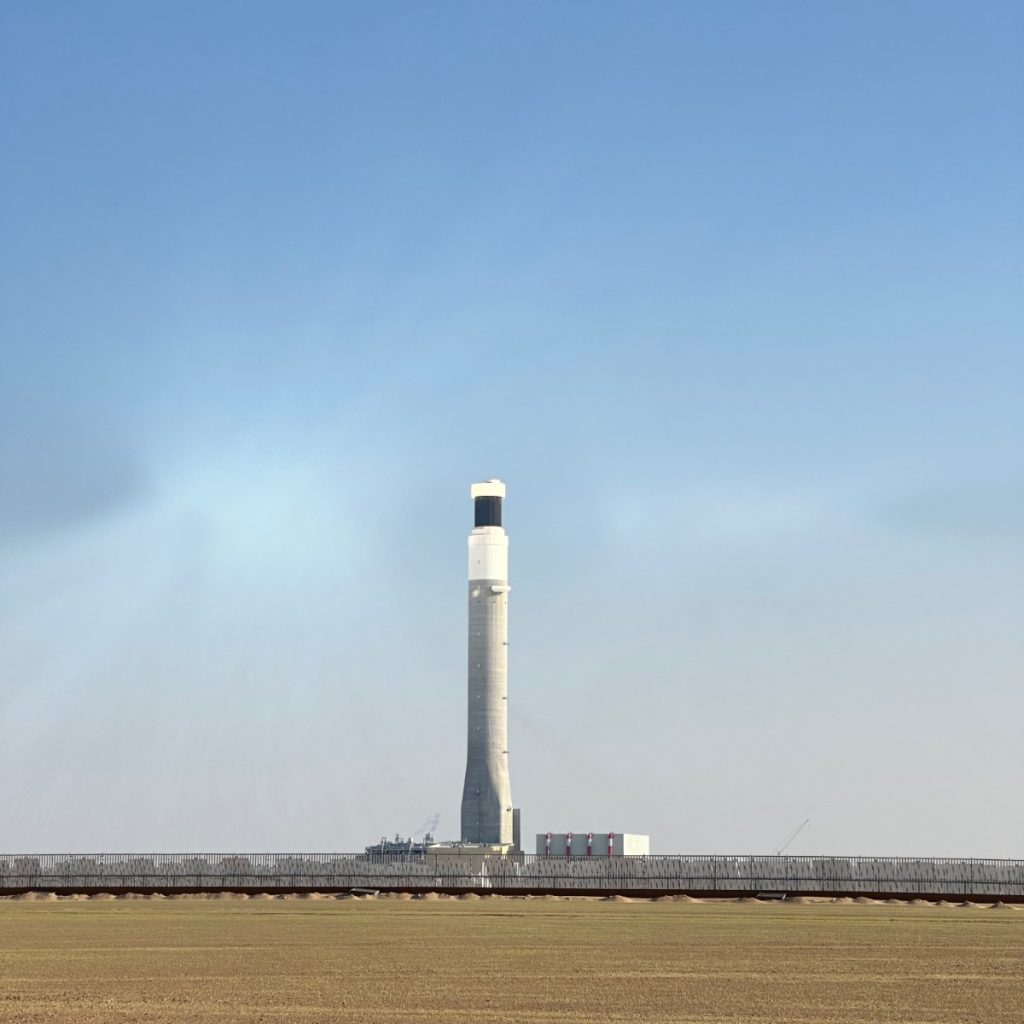
In our drives around Lisaili and Qudra we see a tall structure, that we jokingly call Eye of Sauron or Chimney. Any time we have a break during our drives it always comes up for discussion. I always had something to say about it and this is a post I wrote on the forums.
In recent years, Dubai has been making great strides in its transition to clean energy sources. One of the most innovative projects to come out of this effort is the Molten Salt Power Plant.
So, what is the Molten Salt Power Plant, and how does it work?
Simply put, the Molten Salt Power Plant is a type of energy storage system that uses molten salt to store and release heat. The system consists of a large solar field, where mirrors reflect sunlight onto a central tower, heating up a mixture of molten salts in the process. The heat from the molten salts is then used to generate steam, which drives a turbine to produce electricity.
What sets the Molten Salt Power Plant apart from other energy storage systems is its ability to store heat for long periods of time, allowing it to provide power even when the sun isn’t shining. The molten salts used in the system have a high heat capacity, meaning they can store a large amount of heat energy in a small volume. This makes them an ideal medium for energy storage, as they can be heated and cooled repeatedly without degrading or losing efficiency.
The history of the Molten Salt Power Plant in Dubai dates back to 2016 when Dubai Electricity and Water Authority (DEWA) launched the fourth phase of the Mohammed bin Rashid Al Maktoum Solar Park project. The project aimed to build the largest single-site solar park in the world, with a total capacity of 5,000 megawatts by 2030. The Molten Salt Power Plant was initially planned as a 100 MW energy storage system to support the solar park, but in 2020, DEWA announced plans to expand the system’s capacity to 600 MW.
The Molten Salt Power Plant’s ability to store and release heat at scale makes it a valuable asset for meeting peak demand, reducing carbon emissions, and improving the reliability and stability of the power grid. Additionally, the system’s modular design makes it easy to scale up or down as needed, allowing it to adapt to changing energy demands and technological advances.

Molten Salt Power Plant vs. Photovoltaic Solar Technology:
While both the Molten Salt Power Plant and photovoltaic (PV) solar technology are forms of renewable energy, they differ significantly in terms of their operation and capabilities.
PV solar technology generates electricity directly from sunlight by converting it into direct current (DC) electricity through the use of photovoltaic cells. These cells are typically made from silicon and are arranged in modules that are installed on rooftops, building facades, or large solar fields. PV solar technology is highly versatile and can be used in a range of applications, from powering individual homes to large-scale utility projects.
The Molten Salt Power Plant, on the other hand, uses mirrors to concentrate sunlight onto a central tower, heating up a mixture of molten salts that are used to generate electricity. The system is designed to store heat energy, making it capable of providing power even when the sun isn’t shining. This makes it a valuable asset for meeting peak demand and improving grid stability, as well as reducing carbon emissions.
One of the main advantages of PV solar technology is its scalability. It can be installed on a small or large scale, making it suitable for a wide range of energy needs. It also has a relatively low maintenance cost and can operate efficiently for many years.
The Molten Salt Power Plant, while more complex in its design, has the advantage of being able to store energy for longer periods of time. This makes it a better option for meeting peak demand and providing a stable source of energy for the grid.
The cost of PV solar technology and Molten Salt Power Plants can vary depending on a range of factors, such as location, size, and equipment costs.
Generally speaking, the cost of PV solar technology has decreased significantly in recent years, making it one of the most cost-effective forms of renewable energy. The global weighted average cost of electricity generated by solar PV fell by 82% between 2010 and 2019, with the cost of utility-scale solar PV projects falling by 47% in the same period.
In contrast, Molten Salt Power Plants are generally more expensive to build and operate than PV solar technology, due to the complex nature of the technology and the need for specialized equipment and materials. However, the cost of Molten Salt Power Plants is also decreasing as the technology becomes more widely adopted and economies of scale are achieved.
The cost of electricity (LCOE) for a Molten Salt Power Plant in the US ranges from $0.16/kWh to $0.21/kWh, depending on the size and location of the plant. In comparison, for utility-scale PV solar projects in the US ranges from $0.03/kWh to $0.05/kWh, making it a more cost-effective option currently.
&media=https://looper.ae/wp-content/uploads/2023/04/Chimney.jpeg)